
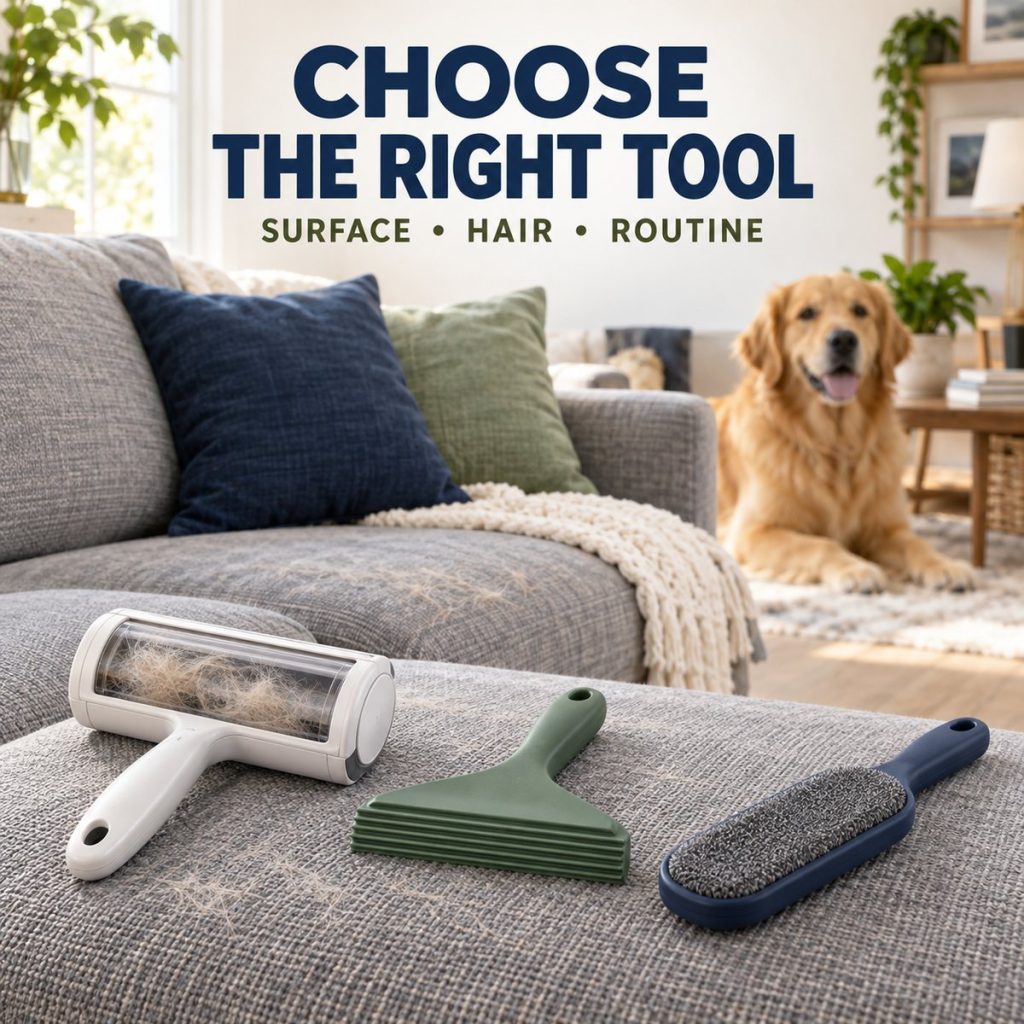

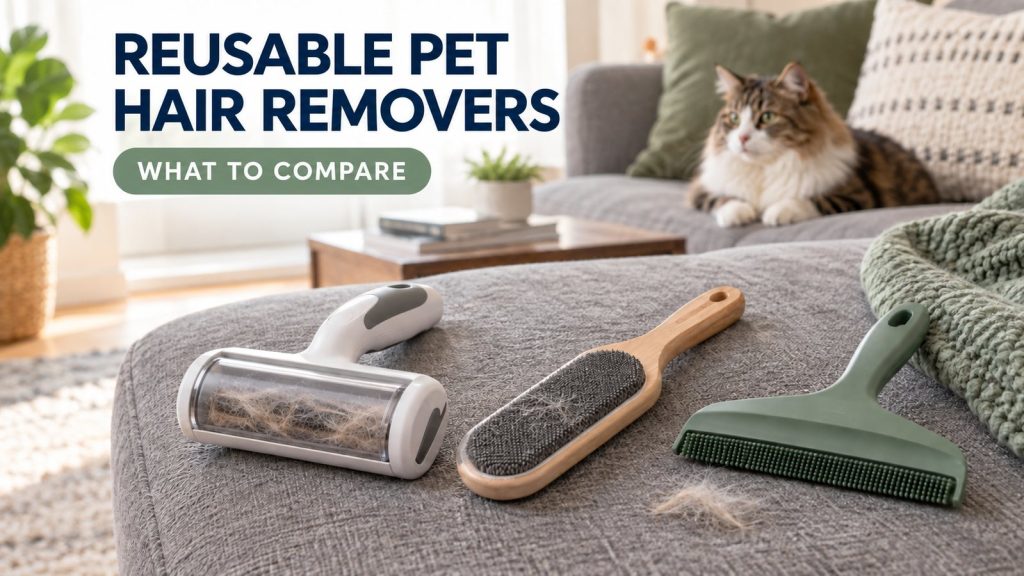
Reusable pet hair removers are easiest to compare when you start with the surface you clean most, not with a long feature list. A broad roller can suit flat upholstery, a directional brush can work well for controlled passes, and a rubber-edged detail tool may reach seams or durable textured areas. The right choice is the one that matches your fabric, the type of hair, your hand comfort, and a cleanup routine you will actually repeat.
Last reviewed: September 14, 2026.
Start with the surface you clean most
Before comparing handles, chambers, or marketing claims, name the first place the tool needs to work. A living-room sofa, a fleece throw, a pet bed, a car seat, and a dark jacket do not present the same surface or access problem.
Look for the furniture or textile care tag before using a new tool. Upholstery cleaning codes mainly address liquids and solvents, but they are still a useful reminder that fabrics have different care limits. Ashley and La-Z-Boy both advise following the code attached to the furniture; code X, for example, limits care to vacuuming or light brushing rather than liquid cleaners. A dry reusable tool does not automatically make aggressive pressure safe.
Write down three details:
- Is the surface flat and taut, or loose and folded?
- Is the weave tight and durable, or delicate, thin, looped, or loosely knitted?
- Does hair sit on top, cling by static, or lodge in seams and texture?
This short check narrows the choice faster than comparing dozens of nearly identical listings.
Match the mechanism to the job
Reusable pet hair removers usually collect hair through a brush surface, friction, a soft edge, or a combination of these. The mechanism affects the motion you use, the surfaces the tool can reach, and how you empty it.
Chamber-style manual rollers
A chamber roller is designed for repeated passes across a relatively broad fabric area. Some models use short back-and-forth strokes to move hair into an internal compartment. That can keep collected hair contained, but only if the roller sits flat enough to engage the surface and the chamber is easy to open and empty.
Compare the usable width, head movement, chamber opening, and clearance around cushion edges. A wide head may save passes on a sofa seat while feeling awkward beside piping, buttons, or a narrow car-seat crease. Check whether the instructions specify one-direction or back-and-forth motion; using the wrong movement can make a reusable tool feel ineffective.
Directional fabric brushes
Directional brushes use a textured or micro-bristle surface that lifts hair during a swipe. Some include arrows, two usable directions, or a base that removes debris from the brush. They can be simple to store and may suit clothing or furniture, depending on the model.
Compare how clearly the direction is marked, whether the handle can be used comfortably from both sides, and how the brush is cleaned. A self-cleaning base still needs a way to release trapped debris. A portable brush should also cover its working surface so collected hair does not move into a bag or drawer.
Rubber-edged and detail tools
A soft edge or blade-shaped tool can gather hair into a line or pile and reach along seams, carpeted steps, pet beds, or car upholstery. The tradeoff is that concentrated contact can be too aggressive for a delicate or loose weave.
Read the surface exclusions before buying. Manufacturer guidance for detail scrapers commonly calls for a hidden-area test and warns against thin, delicate, or loosely woven fabrics. A sharper-looking edge, metal comb, or rigid tooth pattern should not be treated as a universal upgrade. It is a specialized shape that needs a compatible surface and a light hand.
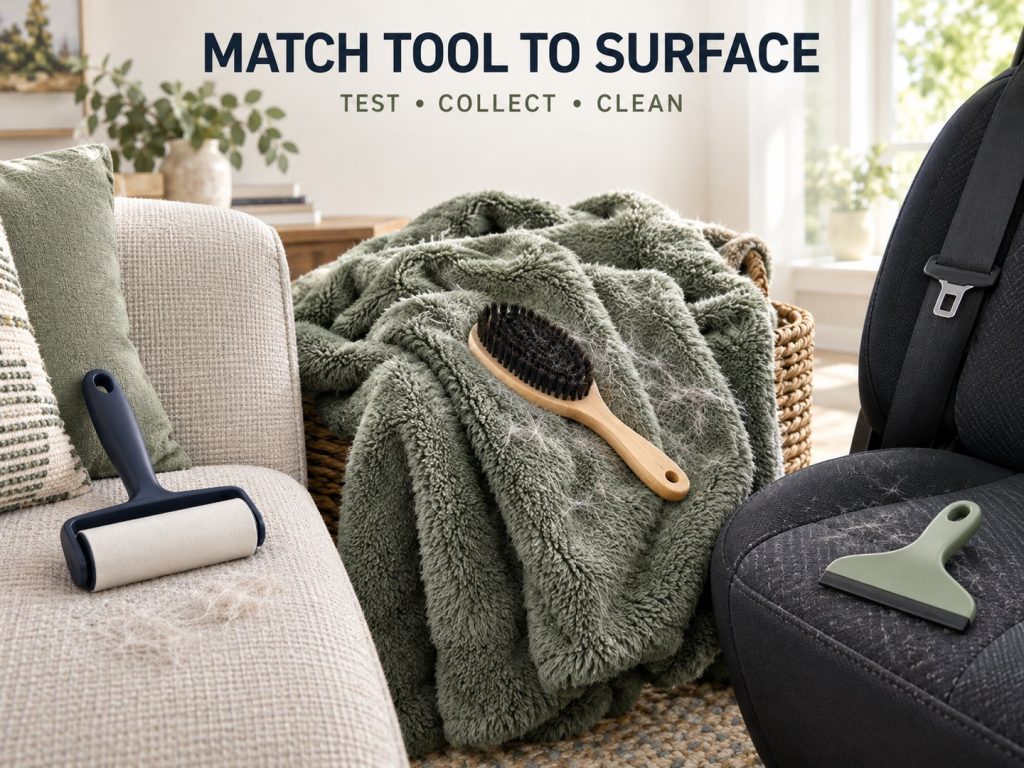
Use a six-point comparison instead of chasing a “best” tool
| Compare | What to check | Why it matters |
| Primary surface | Sofa, blanket, clothing, pet bed, carpet, or car upholstery | A tool that needs a flat surface may struggle in folds or seams. |
| Hair pattern | Long and soft, short and stiff, loose on top, or embedded in texture | Brush and edge designs engage different hair patterns. |
| Working width | Broad head versus narrow detail edge | Width changes both speed and access. |
| Collection | Chamber, cleaning base, brush surface, or gathered pile | Collection determines whether hair stays contained during the routine. |
| Tool care | Wipe, rinse, vacuum, empty, or dry according to instructions | A reusable tool is only practical if its cleanup fits your household. |
| Surface risk | Pressure, edge stiffness, snagging, moisture, and exclusions | The wrong contact method can mark or pull a vulnerable fabric. |
Do not score a tool only by how much hair appears after the first pass. A useful tool should also be easy to control, empty, clean, and return to storage without creating a second mess.
Compare the hair, not only the pet
“Dog hair” and “cat hair” are not precise buying categories. One pet may leave long, soft undercoat on a blanket while another leaves short, stiff hairs embedded in a car seat. The same household can have both patterns.
Soft hair that sits on a broad surface may respond to a fabric brush or chamber roller. Shorter hair lodged in a coarse texture may need a more focused edge or several passes from different directions. These are starting points, not guarantees. Tool construction, fabric condition, static, pressure, and cleaning technique all affect the result.
If most of the problem begins on one couch, use our fabric-first guide on how to remove pet hair from a couch. It explains why broad surfaces, cushion edges, seams, and the nearby floor should be handled as separate zones.
Check reach, grip, and effort
A tool can be reusable and still be impractical if it strains your wrist or cannot reach the places where hair collects. Before buying, look at the handle angle, head width, tool weight, and whether the motion requires repeated pressure.
For a large sofa, consider how many passes the working width will require. For a car, look for a shape that can move beside seat bolsters and between cushions without scraping trim. For clothing, a covered compact brush may be easier to store than a broad furniture roller.
If product dimensions are available, compare them with the actual cleaning zone. Do not assume a larger tool is always faster; a wide fixed head can miss curves and corners, while a very small tool can turn a full sofa into a long project.
Make cleanup part of the buying decision
“Reusable” describes repeated use, but it does not tell you how the tool resets. One design may collect hair in a chamber, another may transfer it into a cleaning base, and another may gather hair into a pile that you pick up separately.
Check these questions before buying:
- Can you see when the chamber or base is full?
- Can it be emptied without touching every collected clump?
- Does the maker say to wipe, rinse, vacuum, or keep the tool dry?
- Does it need time to dry before the next use?
- Is the working edge exposed during storage?
- Are replacement parts or consumables required despite the “reusable” label?
Follow the current instructions for the exact tool. For example, some brushes are vacuumed occasionally, some blades are wiped with a damp towel, and some brush systems are cleaned by inserting them into a base. Do not submerge a tool unless its maker explicitly permits it.
Use a small home comparison before committing to the whole room
When a new tool arrives, begin with a hidden or low-visibility area. Inspect the surface under good light, make a few light passes using the instructed motion, and stop if you see pulling, fuzzing, pilling, color change, or distortion.
If the first check is safe, try the tool on one defined zone rather than the entire sofa. Notice:
- whether it stays in contact with the surface;
- whether hair is collected or merely pushed to an edge;
- how often it needs to be cleared;
- whether your hand can repeat the motion comfortably; and
- whether the fabric looks unchanged afterward.
This is a household compatibility check, not a laboratory test or proof that the tool is safe on every item. Repeat the hidden-area check when moving to a different material.
Avoid these common buying mistakes
Choosing one tool for every material
A durable car carpet and a loose decorative throw should not automatically share the same scraper. Buy for the main surface first, then decide whether a gentler secondary tool is actually necessary.
Assuming more aggressive means more effective
Rigid teeth and concentrated edges can gather embedded hair, but they also raise the need for surface restrictions and careful pressure. Start gently and respect every exclusion in the instructions.
Ignoring the emptying step
A small chamber or awkward base can interrupt a large job. If you clean a sofa covered in hair, collection capacity and easy disposal may matter as much as the pickup surface.
Buying for a rare deep clean instead of the weekly routine
The tool stored beside the surface and used for two minutes may provide more value than a specialized tool that is difficult to retrieve and clean. Match the design to the routine you can maintain.
Treating marketing images as fabric-safety evidence
A product photo showing a sofa does not prove compatibility with every upholstery. Read the maker’s actual instructions, warnings, and surface list, then check your furniture label.
FAQ
Are reusable pet hair removers safe for every couch?
No. Upholstery differs in weave, fiber, finish, age, and condition. Follow the furniture care information and the tool’s surface restrictions, then test a hidden area with light pressure before wider use.
Is a roller or brush better for pet hair?
Neither mechanism is automatically better. A roller may cover broad, taut upholstery efficiently, while a directional brush may suit controlled swipes and portable use. Compare the main surface, hair pattern, motion, collection system, and cleanup.
Can I use a rubber pet hair tool on a knitted blanket?
Only if the tool and textile instructions allow it. Detail edges and scrapers can catch vulnerable loops or loose weaves. For blankets, begin with the care label and the gentlest suitable dry method; our guide to removing pet hair from blankets and throws provides a fabric-first routine.
Do reusable removers replace vacuuming?
Not necessarily. A manual tool can support quick surface pickup, while a vacuum may still be useful for floors, crevices, dust, and a broader room reset. Use each tool for the job its instructions and attachments support.
How many reusable pet hair removers does one home need?
Start with one tool matched to the highest-use surface. Add another only when a different material or access problem cannot be handled safely and conveniently by the first tool.
Sources and care references
The following manufacturer and furniture-care pages were used to verify tool mechanisms, cleaning methods, and fabric-safety boundaries. They are editorial references, not affiliate recommendations.
- Ashley furniture care and cleaning codes
- La-Z-Boy fabric and leather care
- ChomChom manual roller instructions
- OXO FurLifter furniture brush details
- ChomChom detailer surface warning
- Lilly Brush use and care FAQ
Bottom line
Choose a reusable pet hair remover by matching its mechanism to the surface, hair pattern, access problem, and cleanup routine in your home. Compare working width, collection design, care instructions, storage, and fabric restrictions. Test gently before expanding the job, and avoid treating any roller, brush, or detail edge as universally safe or universally best.
Keep building your routine
For fabric-specific methods, read our guides to remove pet hair from a couch and remove pet hair from blankets and throws. Browse more practical guides in Pet Hair Removal, or begin with Start Here.