

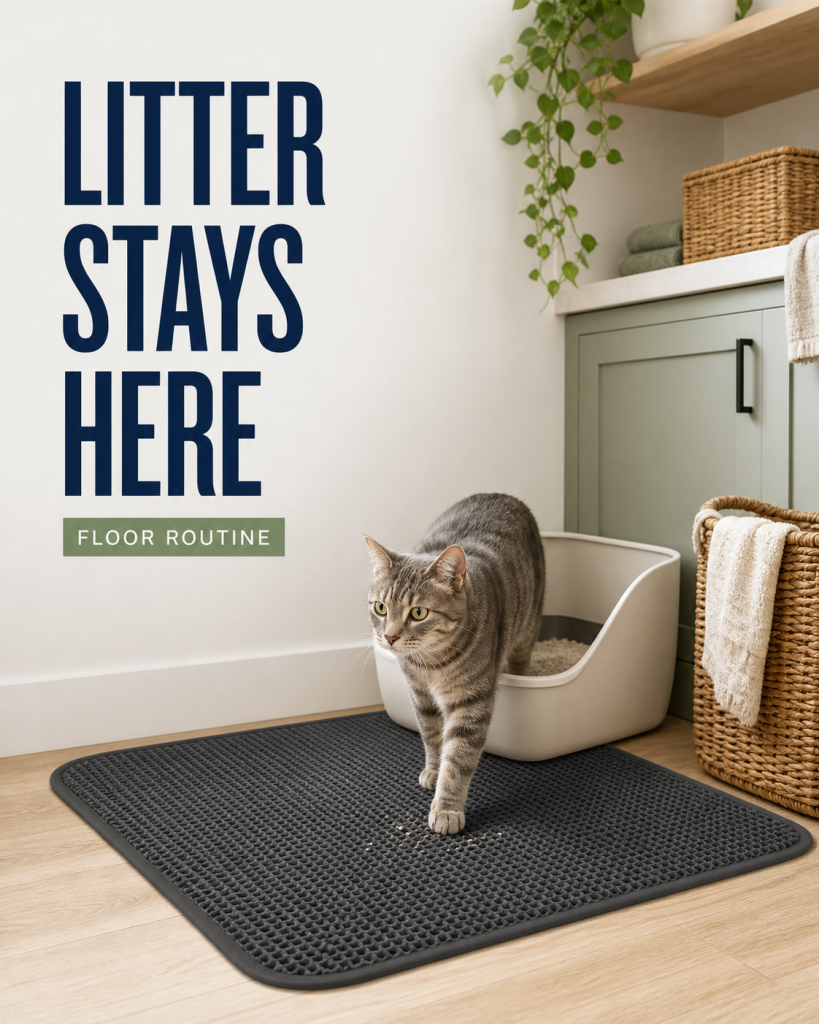

Cat litter tracking is easier to manage when you contain it close to the box instead of chasing individual granules through the house. Start with the route your cat actually takes, create a broad and stable landing zone, and reset the mat edges and nearby floor on a simple schedule. The goal is not a perfectly litter-free room. It is a smaller cleanup area that stays manageable.
Last reviewed: August 26, 2026.
Start with the path the litter actually takes
Before moving the box or buying another mat, watch two or three ordinary exits. Notice where your cat places the first few steps, whether the cat turns left or right, and where loose litter first appears. The useful cleanup zone may extend in front of the box, along one side, or toward the doorway.
Keep the observation calm. Do not stand over the cat, block the exit, or make the litter area feel like a trap. The box should remain easy to approach and leave. If several cats share the home, make sure another animal cannot control the only route into or out of the area.
Mark the practical boundary of the mess: the box, the first landing surface, and the nearest section of open floor. This becomes the area you reset most often. A defined zone is easier to maintain than treating the entire room as one cleanup job.
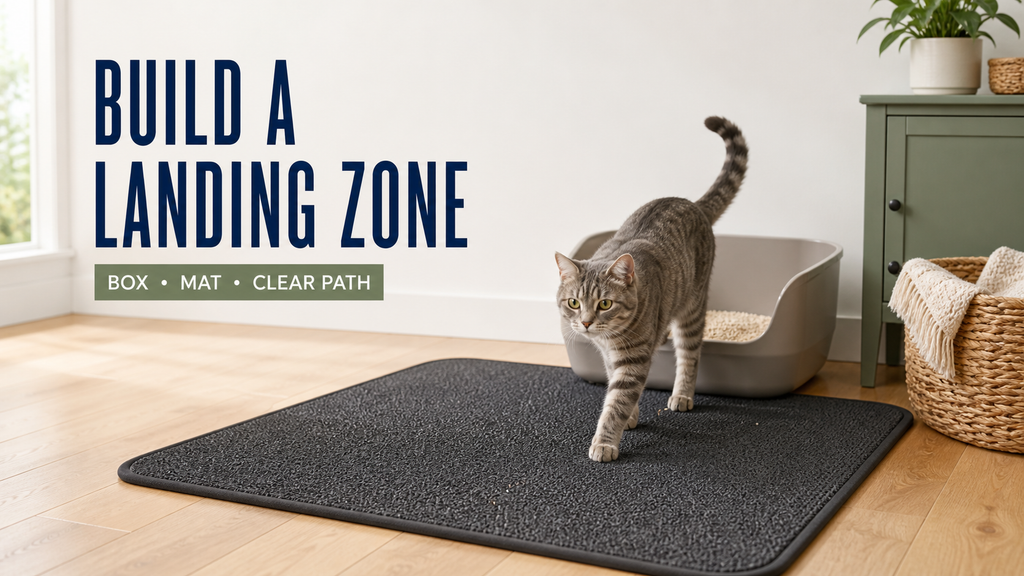
Build a landing zone around the box
A litter mat can be useful, but only when the cat steps on it and the household can clean it. A large mat placed outside the real exit path may do less work than a smaller mat positioned where all four paws naturally land.
Keep the route open
Place the landing surface so it does not create a tight passage between the box and a wall, hamper, shelf, or door. The mat should lie flat, and its edges should not become a new obstacle. Check that the door can open normally and that people can walk through the area without catching a foot on the mat.
For a kitten, senior cat, or cat with mobility limitations, prioritize easy access over a high-sided setup or a complicated barrier. A floor routine should support normal box use, not make the cat climb, squeeze, or jump simply to reach the litter.
Choose a surface you can actually reset
Different mats hold and release litter differently, and no design eliminates tracking in every home. Instead of relying on a material claim, ask practical questions: Can you lift the mat without spilling what it catches? Can you clean it according to its current care instructions? Does it stay flat on your floor? Can it dry fully before it goes back?
If the mat is difficult to move or clean, it may stay dirty longer than planned. A simpler surface you can reset consistently is often more useful than a complex one that does not fit your routine.
Use a two-zone cleanup
Think of the litter area as two connected zones. Zone one is the box and mat. Zone two is the floor immediately beyond the mat, especially along baseboards, under a nearby cabinet, and in the direction of the room exit.
Reset the box and mat first
Scoop and maintain the box on the schedule appropriate for your household and litter system. When the cat is not using the area, collect the dry granules sitting on top of or around the mat. Work from the box outward so you do not carry litter back across a surface you just cleaned.
Follow the care directions for the box, mat, litter, and floor. Avoid making an unverified mixture of cleaning products, and allow any washable surface to dry as directed before putting it back.
Clean the outer edge before litter travels farther
Use a broom, dustpan, or suitable vacuum tool on the nearby dry floor. Before vacuuming, confirm that the appliance and its attachment are intended for the floor and material you are collecting. Do not vacuum wet clumps or anything the appliance manufacturer says to avoid.
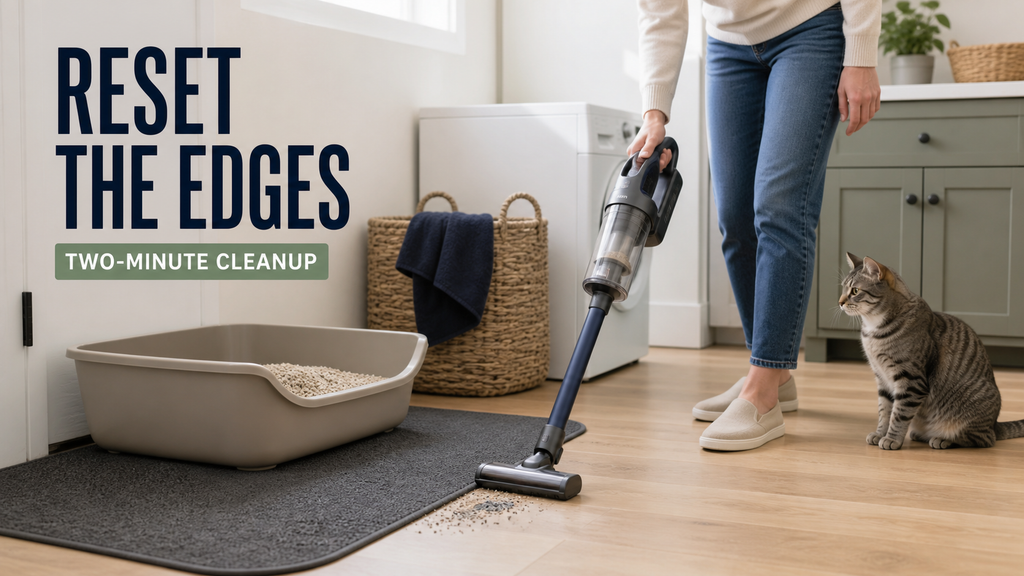
Pay special attention to the outside edge of the mat. That line is where loose litter often moves from the defined landing zone into the rest of the room. A short edge cleanup usually requires less time than waiting until granules reach rugs, furniture, or distant walkways.
Try this two-minute daily reset
The exact timing depends on your cats, litter, flooring, and household, but the sequence can stay simple:
- Wait until the litter area is not in use and the cat has a clear route away.
- Scoop or maintain the box according to your normal routine.
- Collect visible dry litter from the mat, beginning near the box.
- Sweep or vacuum the mat edge and the first section of nearby floor.
- Check that the mat is flat, the path is clear, and supplies are put away.
This is a maintenance pass, not a full wash. If the mat or floor needs wet cleaning, follow its care directions and give it enough time to dry. Keeping daily work small makes it easier to notice when the area actually needs a deeper reset.
A four-question setup check
| Question | What to look for | Why it matters |
|---|---|---|
| Does your cat step on the mat after leaving the box? | Watch the first three or four steps during a normal exit. | The mat has to sit on the real travel path to catch loose litter. |
| Is the exit open and comfortable? | Check for narrow gaps, high edges, blocked sight lines, or another pet nearby. | Easy access is more important than forcing the cat through a cleanup obstacle. |
| Does litter collect beyond one edge? | Look along baseboards, doorways, and the direction people walk. | That edge should be included in the regular dry cleanup. |
| Can the mat and floor be cleaned as directed? | Review the mat label, floor guidance, and appliance instructions. | A routine lasts longer when every surface and tool fits the method. |
Match the routine to your floor and space
Hard floors
On sealed hard flooring, loose granules are easy to see but can travel when people walk through the area. Keep the landing zone away from a door swing when possible, and clean the outer edge before moving to the rest of the room. For any damp cleaning, use only a method suitable for the floor finish.
Carpet near the box
Carpet can hold small particles below the visible surface. Use an attachment intended for that carpet and check the mat frequently so litter is not pressed into the fibers. Avoid aggressive scraping or brushing that could damage the carpet or mat.
Small apartments and shared rooms
In a tight layout, you may not have space for a large station. Keep supplies in a closed container nearby, preserve an open route to the box, and define a compact cleanup boundary that includes the first stretch of floor. Do not move the box repeatedly simply to hide it or make the room look tidier.
Avoid these common mistakes
Choosing a mat before observing the exit path
Dimensions matter, but placement matters too. Measure the available floor area and watch how your cat moves before deciding where the landing surface belongs.
Cleaning only the center of the mat
The outer edge and nearby floor are what connect the litter station to the rest of the home. Include them in the short reset.
Making abrupt litter-box changes to solve a floor problem
Switching the box, litter, location, and mat all at once makes it difficult to see what your cat accepts. Keep floor cleanup separate from unnecessary changes to the cat’s established setup. If a change is needed, make it carefully and monitor normal box use.
Letting cleaning tools block access
A broom, vacuum, storage bin, or folded mat should not sit in the route to the box. Put supplies away after each reset.
Know when tracking is not the main issue
This guide is about dry litter granules carried beyond a box that the cat is otherwise using normally. Sudden avoidance, straining, crying, frequent trips, or elimination outside the box is a different problem. The Cornell Feline Health Center advises that cats with inconsistent litter-box use should be checked by a veterinarian because medical, access, location, and box-preference issues can all matter.
Do not try to solve a possible health or behavior change by adding more barriers around the box. Keep access open and seek appropriate veterinary guidance.
FAQ
Can a litter mat stop all tracking?
No mat can guarantee a litter-free floor in every home. Cat size, coat and paw fur, litter texture, box shape, exit direction, and household traffic all affect where granules travel. Use the mat as one part of a broader landing-zone and edge-cleanup routine.
Is sweeping or vacuuming better for tracked litter?
Use the method that suits the litter, floor, and equipment instructions. A broom and dustpan offer a simple dry option. A suitable vacuum attachment may be convenient for edges or carpet, but it should not be used for wet material or anything the appliance manufacturer excludes.
Should I move the litter box to reduce tracking?
Not automatically. First adjust the landing surface and cleanup boundary around the existing box. If the location creates a safety, access, or cleaning problem, plan any move carefully rather than shifting the box abruptly.
How often should I clean around the litter box?
Use visible buildup and your household’s actual traffic as the guide. A short daily dry reset may keep the defined zone manageable, while washing or deeper floor care should follow the relevant product and surface instructions.
Bottom line
To reduce cat litter tracking, observe the real exit path, give the cat a stable and open landing zone, and clean from the box outward. Reset the mat edge and nearby floor before loose litter reaches the rest of the room. Keep the routine calm, surface-appropriate, and simple enough to repeat without making litter-box access harder.
Keep building your routine
For more practical litter-area and odor-cleanup guidance, browse Litter & Odor. If you are building a manageable pet-home system from the beginning, visit Start Here.


Pingback: How to Keep a Clean Home With Pets: A Room-by-Room Routine
Pingback: How to Set Up a Litter Box in a Small Apartment