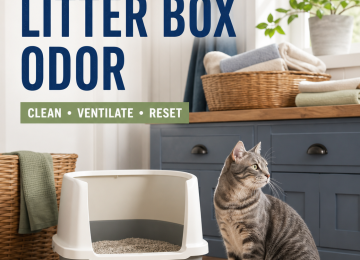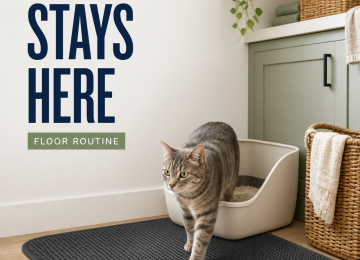

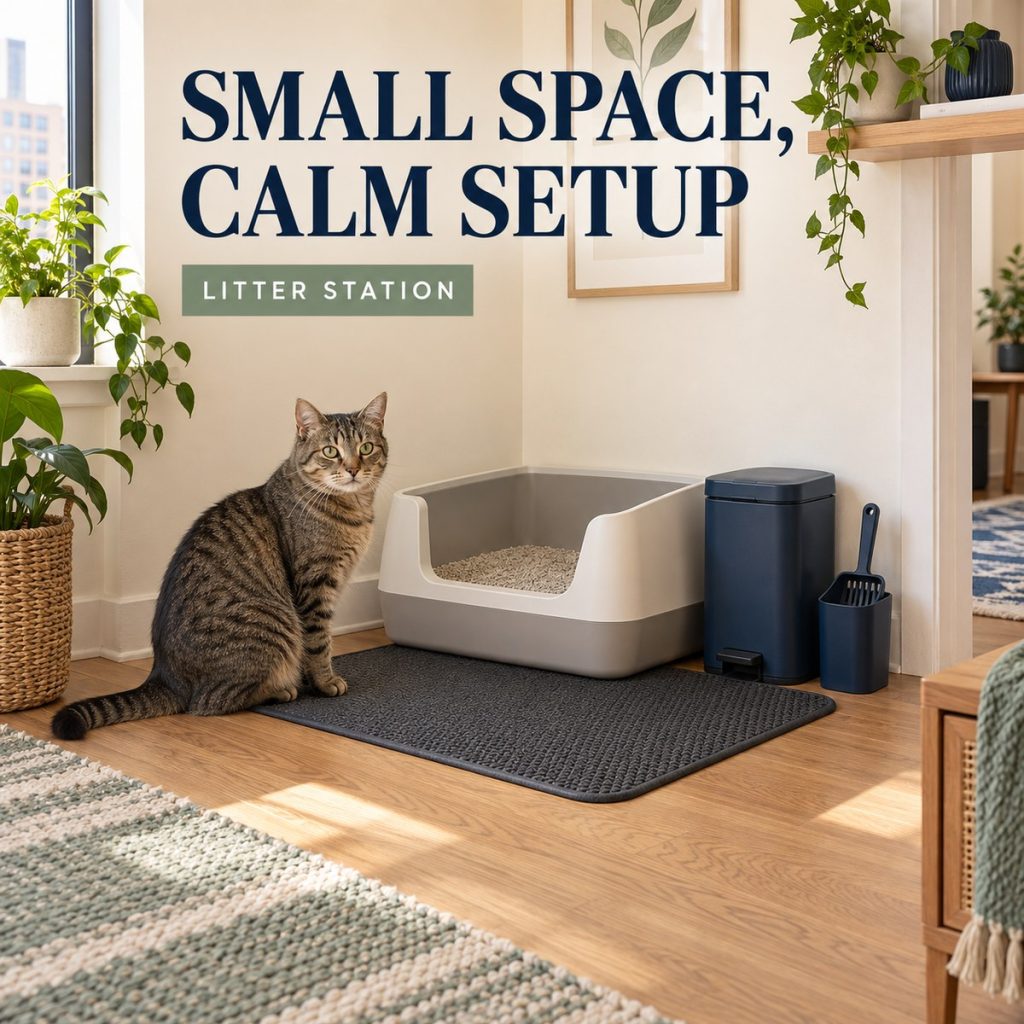

A small apartment litter box setup works best when the cat can reach it at any time, enter without feeling trapped, and leave by a clear route. The human side matters too: you need enough space to scoop, wipe the surrounding floor, move the box when necessary, and carry waste out without crossing food-preparation areas. Start with those routes before choosing a decorative enclosure or trying to hide the box in the smallest possible gap.
Last reviewed: September 29, 2026.
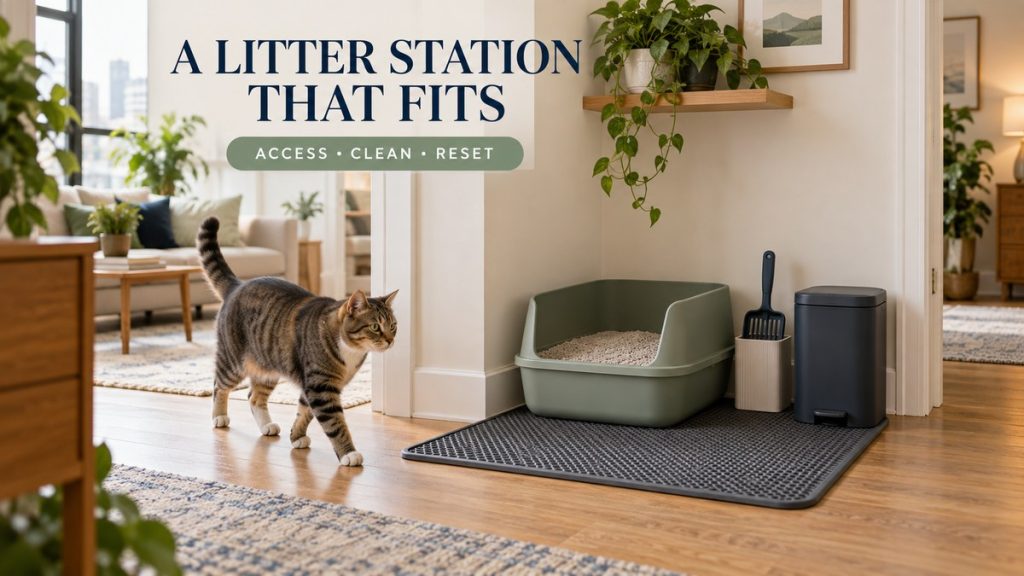
Start with four non-negotiables
Before comparing rooms, eliminate locations that fail the basics.
- Access: the cat can reach the box day and night without waiting for a door to open.
- A calm approach: the route does not force the cat past a loud appliance, busy doorway, dog bed, or narrow dead end.
- Separation from feeding: food and water are not placed beside the litter box.
- Service space: a person can scoop, inspect, and clean the station without lifting the box over furniture.
The Cornell Feline Health Center recommends a quiet, private location that remains accessible and separate from feeding. The ASPCA’s litter-box guidance also warns against locations where a cat can be cornered or blocked. In a small home, “private” should not mean hidden behind a door that is sometimes closed or inside a cabinet with only one narrow opening.
Watch the cat’s actual route for several days. A technically empty corner may still be a poor choice if the washing machine starts beside it, a dog controls the hallway, or guests regularly place bags in front of the entrance.
Measure the whole station, not only the box
A product dimension tells you whether the box fits on the floor. It does not tell you whether the station works. Measure four connected areas:
- Box footprint: the full outside dimensions, including any lip, step, lid, or handle.
- Landing area: enough flat space in front of the exit for the cat to step out normally and for a mat to lie without curling into the walking path.
- Human clearance: room to scoop, lift or slide the box, and wipe the wall and floor edges.
- Service route: a clear path for carrying waste and supplies without moving chairs, bins, or pet dishes.
Mark the footprint with painter’s tape or pieces of paper before moving the box. Open nearby doors and drawers, walk through the route, and kneel as if you were scooping. Check whether the setup still works when the room is being used normally—not only when it is staged and empty.
Compare realistic apartment locations
No location is automatically correct. Use the table as a screening tool, then test the actual noise, traffic, access, and cleaning conditions in your home.
| Possible location | Potential strength | Check before using it |
| Bathroom | Wipeable surfaces and an existing waste route | The door stays open; shower moisture does not keep the area damp; the box does not block the toilet, tub, or walkway |
| Quiet hallway or alcove | Easy access and visibility from more than one direction | It is not a busy passage, narrow dead end, drafty exterior door, or place where a dog can guard the route |
| Laundry area | Hard floor and cleaning supplies may be nearby | Washer and dryer noise or vibration does not startle the cat; chemicals are secured; the box remains accessible when laundry is in use |
| Home office or bedroom edge | Often calmer than a living-room walkway | The door never traps the cat outside; ventilation and daily waste removal are manageable; the station is not beside food or drinking water |
| Closet or furniture enclosure | May reduce visual clutter | The cat is not trapped, ventilation is adequate, the entry is large and unobstructed, the enclosure does not make scooping difficult, and the door cannot close unexpectedly |
If two places seem possible, choose the one with the clearer approach and easier daily service rather than the one that hides the box best. A station that is awkward to reach is less likely to receive consistent attention.
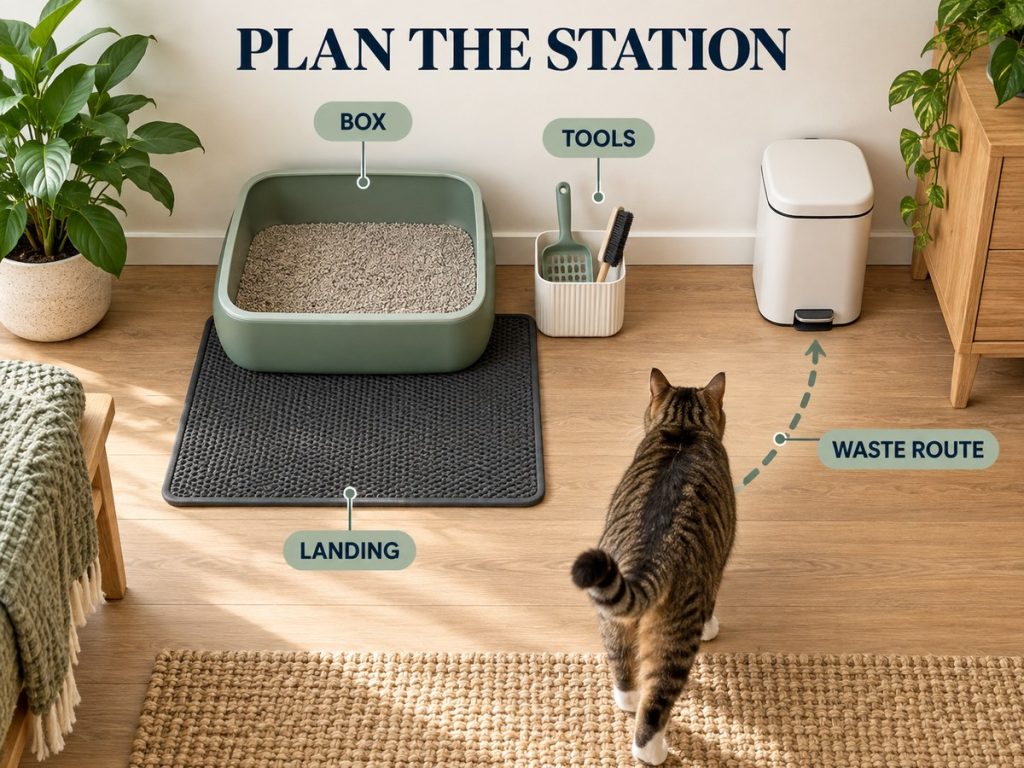
Build the station in four parts
1. The box
Use a box the cat can enter, turn in, and leave comfortably. Age, size, mobility, and established preferences matter. A high-sided or enclosed design is not automatically better in a small apartment, and this article does not recommend changing a box a cat already uses successfully simply for appearance.
Place the box on a stable, level surface. It should not rock when the cat steps in, scrape against a door, or require the cat to jump over stored items.
2. The landing zone
Define a flat area immediately outside the exit. Its purpose is to create a predictable transition from the box to the apartment floor, not to trap every grain of litter. Keep the mat edges flat and the walking path wide enough for both the cat and household members.
For a more detailed exit-path and floor routine, use how to reduce cat litter tracking. That guide covers landing surfaces and cleanup; this page stays focused on the overall station layout.
3. The tool point
Keep a scoop and the small floor tool you actually use near the station, but prevent pets and children from reaching them. The holder should be washable and should not narrow the cat’s approach. Avoid building a large collection of fragrances and cleaners around the box.
4. The waste route
Decide where scooped waste goes before placing the station. A small covered container may be useful if it can be operated and emptied hygienically, but follow local waste rules and do not let waste accumulate merely because the container is out of sight. Keep the path to the household trash simple and away from food preparation.
Keep the approach open in a shared space
Apartment floor plans change during the day. A bathroom door closes, a laundry basket enters the hallway, a vacuum is parked in the alcove, or a visiting dog settles near the route. Treat the approach as part of the station.
During the first week, check the route at morning, evening, and busy household times. Look for:
- a door that can swing across the mat;
- bags, shoes, or baskets placed in front of the box;
- a dog or another cat resting where it can block access;
- a loud appliance cycle near the box;
- cords, cleaners, or small objects within reach; and
- a mat that slides or curls after cleaning.
A clear route is more valuable than a perfectly concealed box. If visual separation is important, use furniture placement or an open screen that preserves more than one line of movement rather than creating a tight tunnel.
Plan for more than one cat
Multi-cat homes need more than a larger station. Cornell and the ASPCA both describe a common starting guideline of one box per cat plus one extra, with boxes in different locations. Several boxes placed side by side may function as one resource because another cat can still guard the shared route.
Small apartments make this difficult, but the principle helps you diagnose the tradeoff. Look for separate accessible zones rather than forcing every box into the same closet or bathroom. Do not place all boxes behind one door that may close. If a cat is avoiding a box, being ambushed, or showing a sudden change in elimination, do not assume the apartment is simply too small; seek veterinary and behavior guidance.
Move an accepted box gradually
Do not abruptly remove the only box a cat reliably uses just because a better-looking location is available. When a move is necessary, place an additional box in the proposed location when practical and observe whether the cat uses it. Keep the old route available during the transition, then make changes gradually.
Avoid changing location, box style, and litter at the same time. Multiple simultaneous changes make it hard to tell what the cat accepts or avoids. If the cat stops using the box, urinates more or less often, strains, cries, produces blood, or shows pain or other sudden changes, contact a veterinarian promptly.
Use a short daily service route
The station should support a routine you can repeat without rearranging the apartment.
- Approach by the same clear route the cat uses.
- Collect litter from the landing zone and immediate floor.
- Remove waste and inspect for unusual changes.
- Wipe visible soil with a method appropriate for the surface and product label.
- Return dry tools to their secured holder and take waste out as planned.
For deeper box cleaning, ventilation, and persistent odor boundaries, continue with how to control litter box odor. Do not mask a service problem with fragrance or use a stronger chemical mixture than a label directs.
Follow litter-handling safety boundaries
The CDC’s toxoplasmosis prevention guidance recommends changing cat litter daily and washing hands afterward. Keep children away from litter and store scoops and waste where they cannot access them.
The CDC advises that pregnant or immunocompromised people have someone else change litter when possible. If that is not possible, its guidance calls for disposable gloves and thorough handwashing. Consult a healthcare professional for personal risk advice; a home-layout article cannot assess an individual’s medical situation.
Never combine cleaners or improvise chemical mixtures around the box. Follow both the box manufacturer’s care directions and every cleaning-product label, ventilate as directed, and keep the cat away until treated surfaces are safe and fully dry.
Avoid these small-space setup mistakes
Hiding the box in a one-way dead end
A decorative cabinet or tight closet can look tidy while leaving the cat with a single narrow exit. Prioritize access and visibility over concealment.
Putting the station beside food and water
Limited floor space does not make the litter box and feeding station compatible neighbors. Separate them and preserve a clean route to each.
Measuring only the plastic box
If there is no room for the landing mat, scoop, or your knees, the station will be difficult to service. Measure the complete footprint.
Letting storage migrate into the route
Laundry baskets, shoes, packages, and cleaning supplies can quietly turn an open approach into an obstacle course. Give those items another home.
Treating avoidance as a decorating problem
Sudden house soiling, straining, pain, unusual urine or stool, appetite changes, or persistent behavior changes require veterinary attention. Moving the box again is not a substitute for evaluation.
FAQ
Where is the best place for a litter box in a small apartment?
Choose a quiet, continuously accessible place with a clear approach and exit, separation from food and water, and enough room for daily scooping and floor care. The best location is the one that meets all of those needs in your actual household routine.
Can a litter box go in a bathroom?
It can if the cat always has access, the door and shower do not block the route, noise and moisture are manageable, and the box does not create a tripping or hygiene problem. Test the full room routine before committing to the location.
Can I put a litter box in a closet or cabinet?
Only if access, ventilation, visibility, escape options, and service space remain adequate and the door cannot close unexpectedly. A tight enclosure should not be used merely to hide the box.
How many litter boxes should a small apartment have?
A common starting guideline is one box per cat plus one extra, placed in different locations. Space constraints are real, but grouping every box together may not provide separate resources. Ask a veterinarian or qualified behavior professional for help when access or conflict is a concern.
What should stay next to the litter box?
Keep only the secured tools used for routine service: a scoop, a washable holder, an appropriate small floor tool, and a practical waste plan. Keep food, water, toys, unsecured cleaners, and unrelated storage away from the station.
Bottom line
A successful small apartment litter box setup is a complete station, not a box hidden in leftover floor space. Protect the cat’s access and escape route, separate the station from feeding, measure the landing and service areas, and keep a simple tool and waste route. The arrangement should make daily care easier without creating a trap, obstacle, or chemical hazard.
Keep building your routine
Use Start Here to choose the recurring mess that affects your home most. For the wider household system, follow how to keep a clean home with pets, or browse more Litter & Odor guides.