

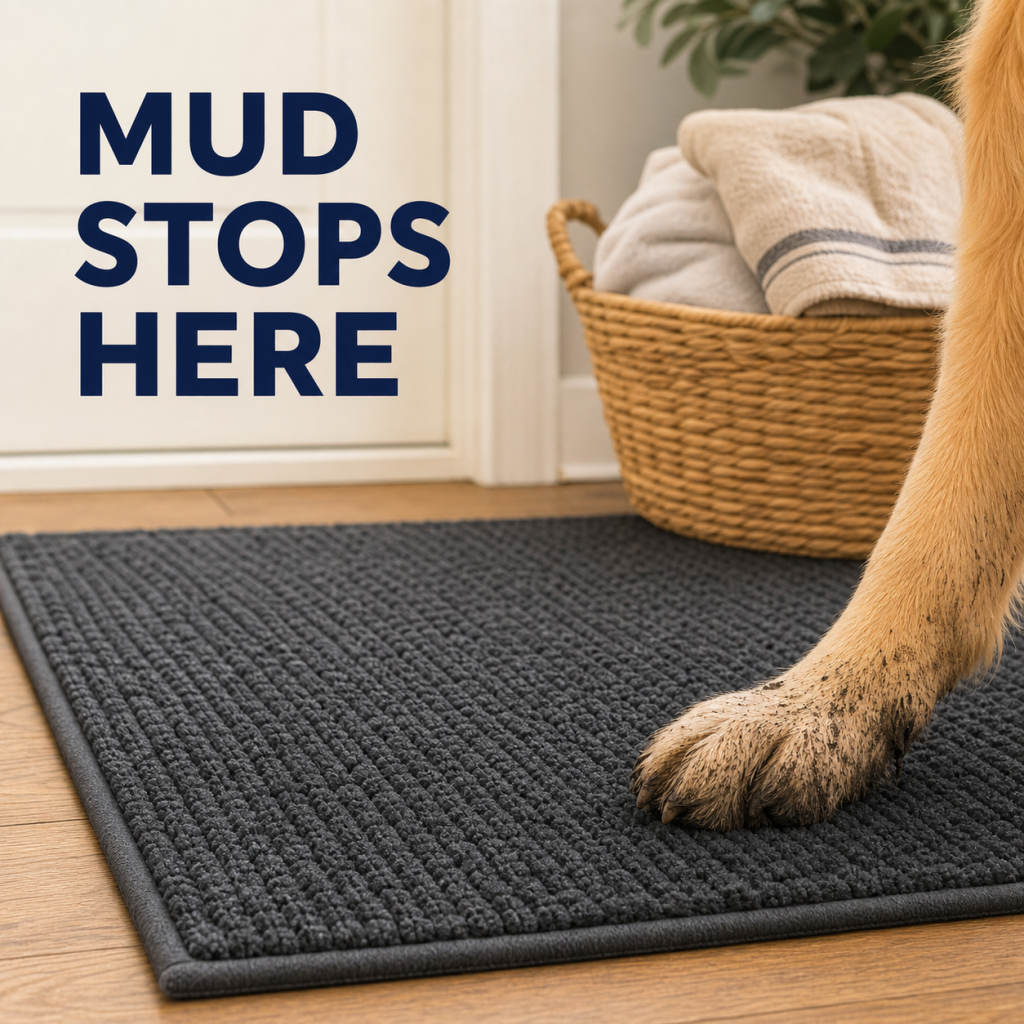

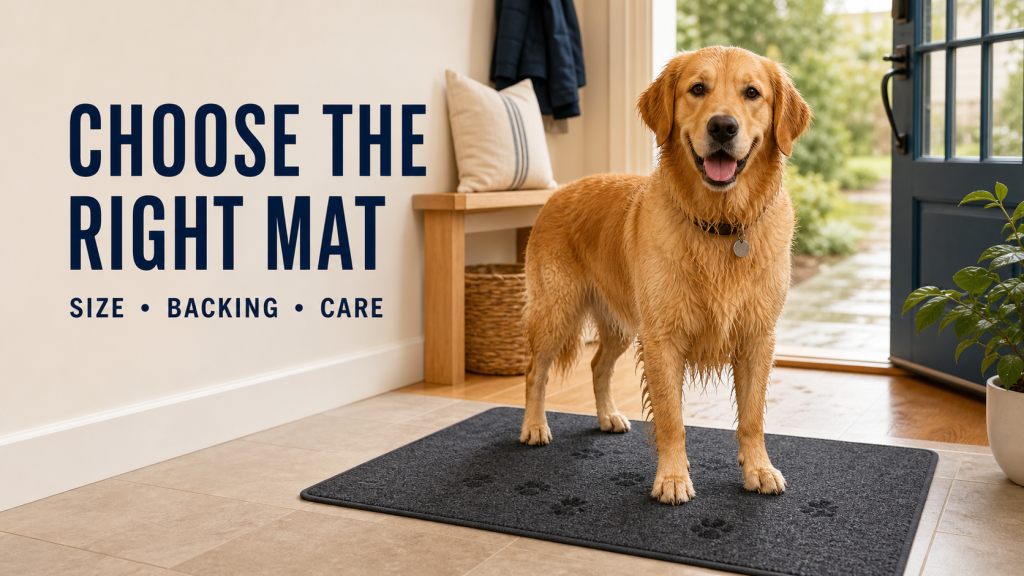
Quick answer: A good washable doormat for dogs is not necessarily the thickest or most decorative one. It is the mat that fits inside your open door, gives your dog enough standing room, stays flat on your flooring, and can be cleaned in a way you will realistically keep up with. Start by measuring the entryway, then compare backing, edge shape, and care instructions before choosing a style.
This is a selection guide, not a test of individual mats. A care label, your floor type, your dog’s size, and the capacity of your washer all matter more than a marketing phrase on a listing.
Last reviewed: July 31, 2026.
Start with the route your dog actually takes
Watch the first few feet inside your door after a wet walk. Does your dog pause by the door, turn toward a leash hook, or head directly to the living room? The best mat is large enough to cover that real stopping point—not simply the empty rectangle in a product photo.
For most homes, the goal is simple: give your dog a defined place to stand while you remove the leash and wipe paws. A mat can catch some loose dirt and moisture, but it is only one part of the routine. Keep a towel nearby and use the mat as the first stop, not as a promise that the rest of the floor will stay perfectly clean.
Measure before you shop
The measurement that matters most is clearance with the door fully open. Measure the depth from the inside of the threshold to the door’s swing path, then measure the width of the usable floor. If the mat is too thick, too long, or curls at the edge, it can interfere with the door or become annoying to step over.
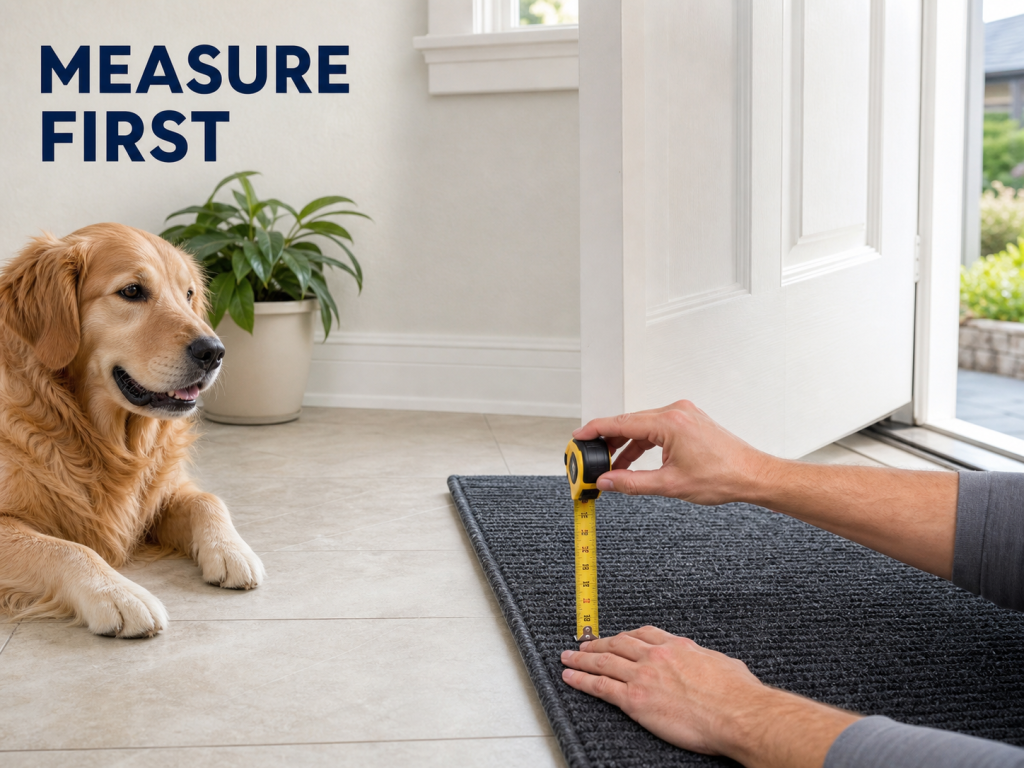
Also consider your dog’s footprint. Your dog should be able to stand with all four paws on the mat for a brief wipe-down. A compact mat may be enough for a small entryway, while a larger dog or an energetic return-from-the-park routine may need more depth than width. Use the dimensions as a planning tool, not a universal rule.
A four-question fit check
| Ask this before buying | Why it matters |
| Can the door open freely over the mat? | It prevents a frustrating fit and helps keep the entry usable. |
| Can the dog stand on it with all four paws? | The mat can then serve as a real pause-and-wipe zone. |
| Does it sit flat on your floor? | A bunched, curled, or sliding edge is not a practical entryway setup. |
| Can you clean it using your actual washer or wash method? | “Washable” helps only when the care routine fits your home. |
Choose backing and edges for your floor
Backing is not a universal feature. A backing that feels secure on tile may behave differently on hardwood, low-pile carpet, or a textured threshold. Read the manufacturer’s current directions for your floor type and test the mat in its final location before making it part of the daily routine.
Look closely at the edges, too. The safest practical target is a mat that lies flat, does not bunch underfoot, and does not create a surprise ridge in a busy path. General fall-prevention guidance also recommends keeping mats flat and walkways clear. If you see curling, fraying, movement, or pooled water around the mat, stop treating it as a finished solution and adjust the setup.
This matters even more in homes with young children, older adults, mobility devices, or an entryway that doubles as a hallway. A pet-cleanup station should make the route calmer—not add a new obstacle.
Read “washable” as a care process, not a feature badge
Before buying, find the actual care instructions. Check whether the mat is machine washable, whether it has a size or load limitation, how it should be dried, and whether the maker gives separate instructions for the backing. A mat that technically can be washed but does not fit in your machine may still be useful, but only if you are willing to rinse, air-dry, or take it elsewhere.
Build a small rotation instead of waiting for one mat to become unpleasant. Two simple mats can be easier than one large mat: one at the door and one drying or being washed. Shake out loose debris outside when practical, follow the care label, and allow the mat to dry fully before placing it back on the floor.
Match the mat to the mess you have
Different routines create different problems. Light rain may mean damp paws and a few leaves. A trail walk can mean grit between pads and splashes on the lower legs. Snowmelt may leave moisture after the visible dirt is gone. The mat should support the work you actually do after each kind of walk.
- Mostly damp paws: prioritize a flat indoor surface, a nearby towel, and a drying plan.
- Loose dirt or leaves: consider an outside-and-inside sequence, with the indoor mat reserved for the paw check.
- Heavy mud: expect a towel, a paw wipe, and sometimes a later floor cleanup; no mat replaces that work.
- Small apartment entry: choose a slim, easy-to-lift option and store towels in a basket or on a removable hook beside the door.
Our guide to stopping muddy dog paws from tracking through the house shows how the mat fits into a short entryway routine.
Avoid these common buying mistakes
Choosing by looks before checking clearance
A thick, plush, or oversized mat may be attractive but still be wrong for the door swing or the available floor. Measure first, keep the packaging until you confirm the fit, and avoid forcing a mat into a tight doorway.
Assuming “non-slip” means no maintenance
No wording on a label replaces a quick check of the installed mat. Floors, moisture, pet hair, and wear can change how a mat behaves. Recheck it after washing, after a storm, and when you notice an edge no longer lying flat.
Buying a mat that your laundry routine cannot handle
Think through the entire cycle: shake out, wash or rinse, dry, and return. If any step is unrealistic, choose a smaller format or use a rotation. A simple mat you can clean is more useful than a large one that stays dirty because it is hard to manage.
Bottom line
Choose a washable doormat for dogs by starting with your doorway, not a product listing. Measure the door swing and floor space, make sure your dog can pause on the surface, read the current care directions, and keep the mat flat and the path clear. Once those basics work, the mat becomes a useful part of a routine you can repeat on ordinary rainy days.
Keep building your routine
New to pet-home cleanup? Begin with Start Here. For more practical entryway, car, and wet-weather ideas, browse Mud & Travel Cleanup.

Pingback: How to Keep a Clean Home With Pets: A Room-by-Room Routine